Al Gore in the news
Al Gore, the former US Vice-President that won the Nobel Peace Prize for his work on climate change is in the news.
Newsweek reports on
the evolution of an eco-prophet, a behind the scenes look at Gore's work and the writing of his new book,
Our Choice: A Plan to Solve the Climate Crisis
. Interestingly it reveals Gore trained 200 Christian ministers and lay leaders in a version of his climate change slide show that is filled with scriptural references. He also has Muslim, Hindu and Jewish training programs coming up.
The New York Times reports on some of
Al Gore's investments in green businesses (aka greentech or cleantech). While some people might want to point out potential conflicts of interest, they would do well to look at the much more serious ethical issue of businesses that advocate a political position supporting industries which are harmful and exploitative.
Disclosure: This post contains Amazon.com affilliate links.
Labels: books, climate change
Climate change has been understood for decades
While it seems that a general consensus about climate change has only emerged in the last few years it is not a new idea. Many people have known about and understood the problem for decades even though people continue to try and cast doubts on it today.
The latest issue of
Cultural Survival Quarterly is on the topic of "Indigenous People and Climate Change". Mark Cherrington
writes:
Just five years ago, governments, pundits, and the general public were talking about climate change -- to the extent they were talking about it at all -- as a vague issue that was open to question. Today it is not just accepted as a fact; it is seen as a crisis. But indigenous peoples have known for decades that climate change is happening, and they know better than most exactly what it means.
Indigenous peoples tend to live close to the land. They are subsistence farmers, herders, fishers, and hunters, with millennia of collective knowledge about the ecology of their surroundings. With that knowledge and experience, even tiny changes in water cycles, wildlife, soil, and weather are readily apparent. An indigenous farmer notices that a certain insect is slightly less abundant this year or that a particular flower is blooming three days earlier.
Unfortunately, the same closeness to the land that has given indigenous peoples early warning about global warming also means that they suffer the consequences of it to a far greater degree than others. The trends of history and hegemony have left many indigenous peoples living on land that is already marginal, so even relatively small changes in temperature or rainfall have an outsized consequence.
Some of the world's best scientists were all quite aware of it too.
An article from The Times writes about "Jason", a group of leading scientists including a number of Nobel Prize winners engaged by the US Government to think about the big issues.
Recent research reveals how the roots of this argument stretch back to two hugely influential reports written almost 30 years ago.
These reports involve a secret organisation of American scientists reporting to the US Department of Defense. At the highest levels of the American government, officials pondered whether global warming was a significant new threat to civilisation. They turned for advice to the elite special forces of the scientific world – a shadowy organisation known as Jason. Even today few people have heard of Jason. It was established in 1960 at the height of the cold war when a group of physicists who had helped to develop the atomic bomb proposed a new organisation that would – to quote one of its founders – “inject new ideas into national defence”.
[snip]
In 1977 they got to work on global warming. There was one potential problem. Only a few of them knew anything about climatology. To get a better understanding they relocated for a few days to Boulder, Colorado, the base for NCAR – the National Center for Atmospheric Research – where they heard the latest information on climate change. Then, being physicists, they went back to first principles and decided to build a model of the climate system. Officially it was called Features of Energy-Budget Climate Models: An Example of Weather-Driven Climate Stability, but it was dubbed the Jason Model of the World.
In 1979 they produced their report: coded JSR-78-07 and entitled The Long Term Impact of Atmospheric Carbon Dioxide on Climate. Now, with the benefit of hind-sight, it is remarkable how prescient it was.
When climate change impacts become even more severe and historians look back at humanity's failure to act they won't be able to say it was because we didn't know. Politicians and lobby groups taking care of vested interests will have a lot to answer for.
Labels: climate change
The cost of climate change

Today is
World Environment Day. The theme for this year's event is "CO2, Kick the Habit! Towards a Low Carbon Economy." I have already written a post about
climate change and Taiwan at David on Formosa.
I was struck by this
alarming article from the ABC about how climate change is affecting the Pacific island nation of
Kiribati. Kiribati is a nation of low lying coral attols with a population of about 100,000 people. President Tong is in New Zealand for talks about relocating his people.
The IPCC forecasts sea level changes by the end of this century of 18-59 cm. This estimate is probably conservative. If the entire Greenland ice cap were to melt sea levels could rise by seven metres. The West Antarctic Ice Sheet would have a similar effect. This would be catastrophic for the entire world. (
US EPA)
Australia has been slow to react to the problem of climate refugees, but this issue is likely to become more serious in the next decade. Australia has the capacity to host the refugees from Pacific Island nations. I would like to suggest an innovative way it could do this.
The people of Kiribati (or Tuvalu or other island nations) could be offered a piece of land on which to resettle. Not all of them would necessarily move at the same time. Initially at least a few thousand would need to move to establish a working community.
The land would need to be along the coast as fishing and living by the ocean is an important part of their culture. People would come under state and federal laws of Australia but form their own local government. As Kiribati is a former British colony there should be no major problems with this. People would be free to use their own native language and the school curriculum would be bilingual.
Development of the land would be a model of ecological sustainability. The community would aim to develop in a way that is carbon neutral (although some carbon emissions may be necessary in the early stages of development). They would seek to develop a local economy that provided for as many needs as possible as well as some industries producing surpluses for sale to outside.
As the community developed its economy and infrastructure more people could relocate from the islands to the new community. If the space or resources were limited a second community could be established based on the lessons learnt from the first.
Of course detailed plans and financial support would be required to realise this idea. However, to not attempt to solve the problem is to condemn an entire nation to extinction.
Labels: climate change, environment
Dismissing the global warming skeptics
Despite the fact that the evidence for climate change is now overwhelming some people still don't want to believe. They would prefer to think it is some kind of conspiracy, hoax or scam. George Monbiot suggests
four questions for the skeptics.
1. Does the atmosphere contain carbon dioxide?
2. Does atmospheric carbon dioxide influence global temperatures?
3. Will that influence be enhanced by the addition of more carbon dioxide?
4. Have human activities led to a net emission of carbon dioxide?
He also has debunks some of the
junk science put forward. In this case the ridiculous claims of David Bellamy. Paradoxically a
Google search for junk science brings up
JunkScience.com as the first result. This website actually tries to prove that global warming is a hoax. I would like to ask them to produce a single refereed article from a reputable scientific journal proving it.
Labels: climate change, environment
Contraction and convergence

This is one of my favorite cartoons. It illustrates so many issues in world politics. It highlights the need for
contraction and convergence as a solution to climate change. This would also solve many of the problems related to global inequality.
If I had the artistic skills I would like to draw a similar cartoon of the world in 2050. In it there would be no divide and all the people would be living in a peaceful, happy world without extreme poverty or extreme wealth.
*cartoon by Nicholson,
www.nicholsoncartoons.com.au.
Labels: climate change, environment
Climate change is real

This graphic comes from the
Taiwan News, 16 January 2007. It shows very clearly the rapid increase in global temperatures, particularly since 1980.
Labels: climate change, environment
The power of ideas
I have recently read a couple of books and seen one movie that show how powerful ideas can be.
The first is the book
Freakonomics by Steven Levitt. Levitt is an economist that asks questions that most people would never think of. For example, why do most crack dealers live with their mothers? In doing so he reveals that what the commonly accepted explanation for things is not necessarily the best one. While Levitt's theories are firmly grounded in mainstream economics theory I like his way of thinking.
Levitt cites
The Tipping Point by Malcom Gladwell a number of times and it has obviously influenced his work. It was a book I first heard about several years ago. The sub-title of the book is "How little things can make a big difference".
Like Levitt, Gladwell thinks outside the box. His ideas are applicable to a number of fields, most notably marketing, management, education and activism.
One of the important ideas in The Tipping Point is the idea of "connectors". These are people that have a large number of contacts and a disproportionate impact in the spreading of information. Most people have a small circle of friends and often those friends are also friends with each other. Connectors, on the other hand, have contact with a wide range of people. Their contacts are not limited to certain location or people with certain interests.
Obviously these people not only talk to more people, but the people they talk to a wider range of people. This is a key in making ideas spread.
Al Gore would easily qualify as a connector. A long career in politics including eight years as Vice-President of the United States would have bought him into contact with innumerable people around the world. And when he talks people listen to what he has to say.
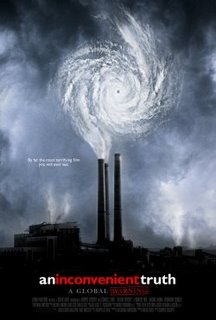
He has made a documentary called
An Inconvenient Truth about climate change. Interestingly Gore had a professor while he was at university in the 1960s who was one of the first people to measure CO2 levels in the atmosphere. Gore has known about and understood the problem for a long time.
He explains it all in a very clear manner in the film. Anyone who doesn't understand climate change or quite believe that its real should be convinced by the end of this movie. If they remain unconvinced then surely it would be because of political ideologies that remain unchangeable.
Action on climate change has been delayed for too long because those with vested interests in the status quo have been very successful in sowing seeds of doubt about whether climate change is really happening. Hopefully this film will act as a tipping point and convince enough people that it is real and something needs to be done now!
I highly recommend this film and also
The Tipping Point.
Technorati tags: Al Gore | climate change | global warming | An Inconvenient Truth | freakonomics | The Tipping Point | ideasLabels: books, climate change, movies
"Balanced" reporting is biased
I often think society is overly obsessed with bias in the media. Or perhaps to put it in another way it rails at one kind of bias and ignores another.
First, there can really be no such thing as an entirely objective reporting, or if there was it would be too bland and uninformative. Second, different weight needs to be given to different opinions. The same amount of words or time doesn't need to be given to opposing views if they have little credibility or merit.
Sharon Beder wrote a great opinion piece about this in
The Age yesterday.
The officious policing of impartiality and balance will mean ensuring that statements by those challenging the establishment (government or business) are balanced with statements by those whom they are criticising, though not necessarily the other way round.
Too much emphasis on objectivity in news and current affairs can lead journalists to leave out interpretations and analysis, which might be construed as personal views, and to play it safe by reporting events without explaining their meaning and keeping stories light and superficial so as not to offend anyone.
Journalists who accurately report what their sources say, can effectively remove responsibility for their stories onto the people they interview and quote. The ideal of objectivity therefore encourages uncritical reporting of official statements and those of authority figures. In this way, the biases of individual journalists are avoided but institutional biases are reinforced.
The enforcement of impartiality tends to give powerful industry spokespeople guaranteed access to the media, no matter how flimsy their argument or how transparently self-interested. No such access is guaranteed to critics.
No where is this more evident than in reporting on climate change. Despite the overwhelming scientific consensus (not to mention clearly visible evidence) that climate change is happening, media reports often include the opinions of pseudo-scientific experts who disagree that climate change is real. Often these experts are funded by fossil fuel companies or other groups with vested interests.
Beder writes,
In their attempts to be balanced on a scientific story, journalists may use any opposing view even when it has little scientific credibility in the wider scientific community. This can be very misleading. In the case of global warming, the fossil fuel industry has taken advantage of this convention by funding a handful of dissidents and demanding that they are given equal media coverage despite their poor standing in the scientific community.
This strategy of exaggerating the uncertainties and confusing the public has ensured that governments such as the Howard Government have been able to avoid doing anything to prevent global warming, despite the overwhelming evidence that significant global warming is likely without government intervention.
It is only recently, after many precious years have been lost, that the most intransigent governments have been forced to admit that action must be taken to avoid global warming. Some ask why this has not occurred earlier. Clearly part of the problem has been the ability of vested interests to manipulate the media by holding up the rod of balance and impartiality.
There has been a noticeable shift in media reporting on climate change in the past year or so. It may be decades too late, but hopefully those who dispute climate change will soon belong in the same category as creation scientists or flat earthers. Then we can start working to solve this problem and not just argue about it.
Technorati tags: climate change |
global warming |
media bias |
journalism |
Sharon BederLabels: climate change, media